
Summary and editorial
Article Sidebar
Main Article Content
Abstract
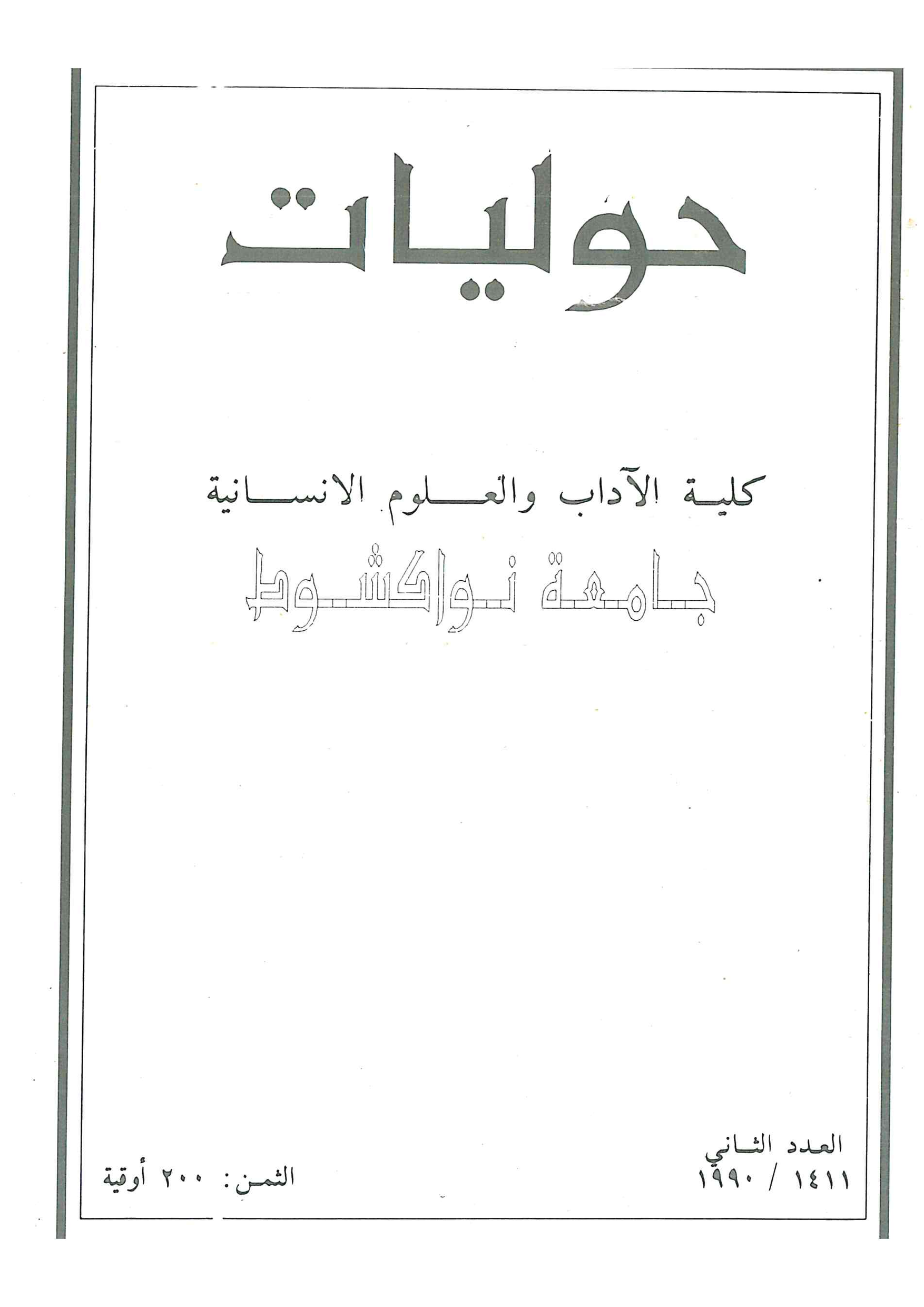
«The Annals» of the Faculty of Letters and Humanities of the University of Nouakchott presents its second issue to researchers, students, and its readership, for the second consecutive year.
This opportunity is taken to reaffirm its commitment to the continuity of calm and rigorous scientific research.
Indeed, while the primary objective of this journal remains to bring forth, develop, and consolidate knowledge of our country and its cultural values, the studies published in it also seek to help address certain evident shortcomings affecting other fields of knowledge.
While the main concern of some of our researchers appears to be the study of local social phenomena—which is also justified by the existence of a particular sensitivity and expectations at the national level—others, by contrast, address a broader field of inquiry, free from circumstantial constraints and thereby extending to other cultural spheres.
This issue includes various studies presented in Arabic, French, or English and grouped into two sections:
The first section consists of a body of analyses dealing with Mauritanian society, its history, the sociology of its development, and its literature.
A group of researchers has undertaken the study of the prehistory of our country through archaeological data collected during a research mission conducted in the Tijirit region.
A more recent period is presented by Deddoud Ould Abdellah, who discusses the spread of Islam in West Africa during the seventeenth and eighteenth centuries and the role played by the “çhenagita” in that expansion. Mohamed El Mokhtar Ould Saad, for his part, examines the emergence of the Emirate system in Mauritania and its territorial and human dimensions during the eighteenth and nineteenth centuries, using the Emirate of Trarza as a model. Mohamed Said Ould Ahmedou focuses his study on the role of the gum trade in the nineteenth century in relations between the Mauritanian Emirates and the French colony of Saint-Louis in Senegal, while Mohamedou Ould Mohamedhen rewrites this history on the basis of accounts produced by European travellers during the same period.
In the field of geography, Moustapha Tahar addresses the issue of spatial planning and its impact on the country’s economic development. In the field of education, Ghadoury Ould Semane analyses the teaching of English in Mauritania and the difficulties it presents.
This “Mauritania” dossier concludes with a study of the Mauritanian novel in its general aspects relating to literature, language, and thought in general.
In the field of comparative literature, Mohamed Ould Boulelba examines Marxist influences on Lebanese criticism, taking the work of Yumna I-Id as a model.
A philosophical approach to the problem of pedagogy and education is presented by Ahmed Ould Gaouad through an analysis of the notion of Derision as it develops in the work of the French writer Louis Guilloux.
Christian Roques revisits the debate that took place among Greek philosophers concerning the “Master Argument” of Diodorus Cronus and argues, contrary to the usual interpretation, that this debate did not oppose supporters and opponents of the idea of freedom.
In the field of linguistics, Yahya Ould El-Barâ studies the grammatical forms “INVA ALA” and “IVTA ALA” from a perspective inspired by modern linguistic theories.
Mohamed Salem Ould Salah then examines the place assigned to language in Ibn Hazm’s classification of knowledge.
Finally, Seyid Ould Bah studies Althusser’s theory of Discourse.
We hope that the reader will find here what they are entitled to expect from a journal whose ambition is to comply with academic, university, and scientific standards.
The Editorial Board
Article Details

This work is licensed under a Creative Commons Attribution 4.0 International License.
Authors retain copyright in their work and grant the Annals of the Faculty of Arts and Humanities the right of first publication. Articles are published under the Creative Commons Attribution 4.0 International License (CC BY 4.0), which permits the use, distribution, reproduction, and adaptation of the work, provided that appropriate credit is given to the author, the original publication in the journal is acknowledged, and any changes made are indicated.